When accounting records fall behind, or no longer reflect operational reality, the problem is rarely just missing transactions. Structured remediation addresses root causes, not just visible symptoms.
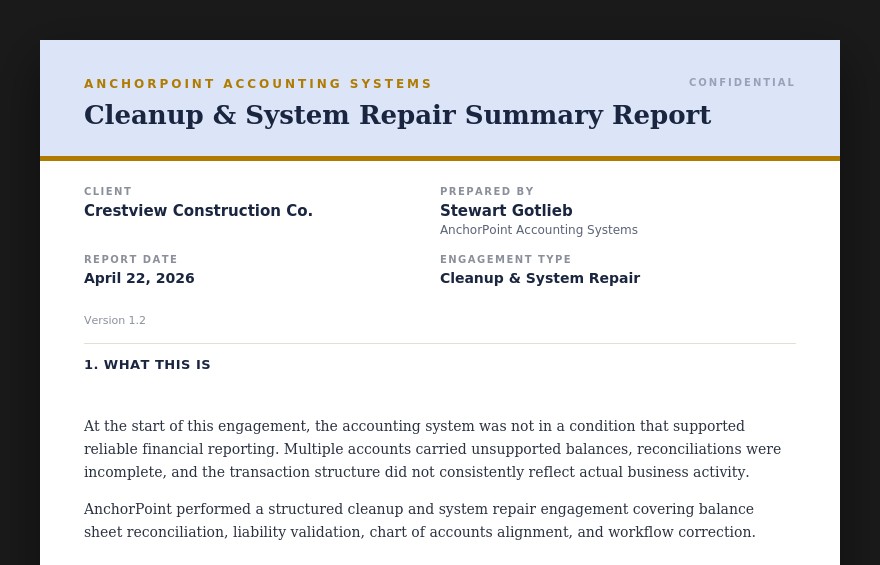
Every repair engagement concludes with a summary report documenting what was found and what was corrected.
Cleanup work often goes beyond entering missing transactions. It requires restoring balance sheet integrity, correcting liability accounts, and repairing accounting workflows that have broken down over time.
AnchorPoint specializes in comprehensive cleanup and system repair, not just transaction entry. Before any repair work begins, a Structured Diagnostic Review establishes the actual condition of the system and the correct path forward.
Most problems that look like cleanup are actually structural, and structural problems require a different kind of work.
Most cleanup situations aren't just missing transactions. They fall into two distinct categories that require different approaches.
Transactions need to be recorded and reconciled. The system structure is intact. Work simply fell behind.
The balance sheet no longer ties to real obligations. Liabilities don't match filings. The system itself has drifted out of alignment.
Most problems that look like cleanup are actually structural. Without a diagnostic first, catch-up work may be done correctly while the structural issues remain intact.
Remediation scope is determined by the diagnostic. The work that follows is targeted to the actual condition of the system, not estimated from the outside.
Systematic correction of bookkeeping that has fallen significantly behind: coded, reconciled, and brought to a defensible close.
Bank, credit card, and other account reconciliations worked back to the point where the accounts were last clean and reconciled forward from there.
Identifying and correcting balance sheet accounts that have accumulated balances no longer tied to actual business assets, liabilities, or equity.
Clearing and suspense accounts that have accumulated instead of resolving, diagnosed and corrected to eliminate the source of distortion.
Where the account structure itself is creating reporting problems, restructured to produce financial statements that reflect the actual business.
Payroll liability accounts reconciled to actual filings, one of the most frequently mishandled areas in QuickBooks and a common source of balance sheet distortion.
Sales tax liability balances verified against actual filings and corrected where mismatches exist, often compounded across multiple periods.
The end goal of all repair work: an income statement and balance sheet that leadership can trust for business decisions and that supports accurate tax preparation.
Repair work follows a structured sequence, from diagnostic findings through targeted correction to a confirmed clean close. Each phase builds on the last.
Repair begins with the written findings from the diagnostic. Scope is confirmed, priorities are set, and the remediation sequence is established.
Root-cause corrections applied first: balance sheet accounts, liability balances, clearing accounts, chart of accounts, before transaction-level cleanup begins.
All key accounts reconciled period by period from the last clean close: bank, credit card, payroll, sales tax, and other critical accounts.
A confirmed clean close: balance sheet ties, reconciliations are current, financials are defensible. The system is ready for ongoing structured maintenance.
Cleanup and repair work is complete when the books are defensible, not just tidier. Every deliverable is measurable against an objective standard.
The goal of cleanup work is not just clean-looking books. It is a system that produces reliable financial information going forward.
That requires addressing the structural issues that caused the deterioration, not just recording the transactions that were missed while it was happening.
Cleanup work cannot be scoped accurately from the outside. Before any remediation begins, a Structured Diagnostic Review identifies the structural source of the problem and defines the repair sequence required to fix it.
This ensures the work that follows is targeted to the actual condition of the system, not estimated from visible symptoms.
Cleanup and repair is Phase 2 of a three-phase method designed to restore and then maintain financial system integrity.
Assess the system. Identify what is broken and why. Establish the remediation roadmap.
Reconcile the balance sheet. Correct liabilities. Restore system integrity. You are here.
Structured monthly close. All key accounts reconciled. Reliable financials every period.
Reconciliations are behind and it's unclear how far back the problems go
Balance sheet accounts have balances that don't correspond to real business obligations
Payroll or sales tax liability accounts don't tie to what was actually filed
Cleanup has been done before, and the same problems reappeared
Financial reports exist but leadership can no longer rely on the numbers
A business event, such as a sale, financing, or audit, requires books that are defensible
Every cleanup engagement begins with a Structured Diagnostic Review, so the work that follows is targeted to what is actually broken. No assumptions, no shortcuts.
Schedule a Diagnostic ReviewBirmingham, Alabama · Serving businesses nationwide
Or call: (205) 719-6480