When financial reports stop reflecting what’s actually happening in the business, the issue is rarely just missing transactions. Before any cleanup begins, you need to know what is actually broken, and how deep it goes.
Every Diagnostic Review concludes with a written findings report: system classification, root causes, and a recommended remediation path.
Cleanup work is often treated as a volume problem: “How far behind are the books?” But in many cases, the issue isn’t volume — it’s structure.
“Without diagnosing the system first, you can’t know whether you’re solving the right problem.”
Without an accurate diagnostic, cleanup work risks being mis-scoped from the start. The result is work that addresses visible symptoms while structural issues remain intact, and the same problems return.
The real question before any work begins: what is actually broken, and how deep does it go?
Without understanding how transactions flow through the system, work is estimated based on visible symptoms, not actual condition. Scope errors mean the work isn’t priced correctly and may not address root causes.
Balance sheet accounts can look wrong for many reasons. Without identifying the actual source, corrections address the symptom, not the cause. Six months later, the same balances are off again.
Every AnchorPoint engagement begins here. The diagnostic establishes the root cause of the breakdown and the correct sequence to repair it, so the work that follows is targeted and complete.
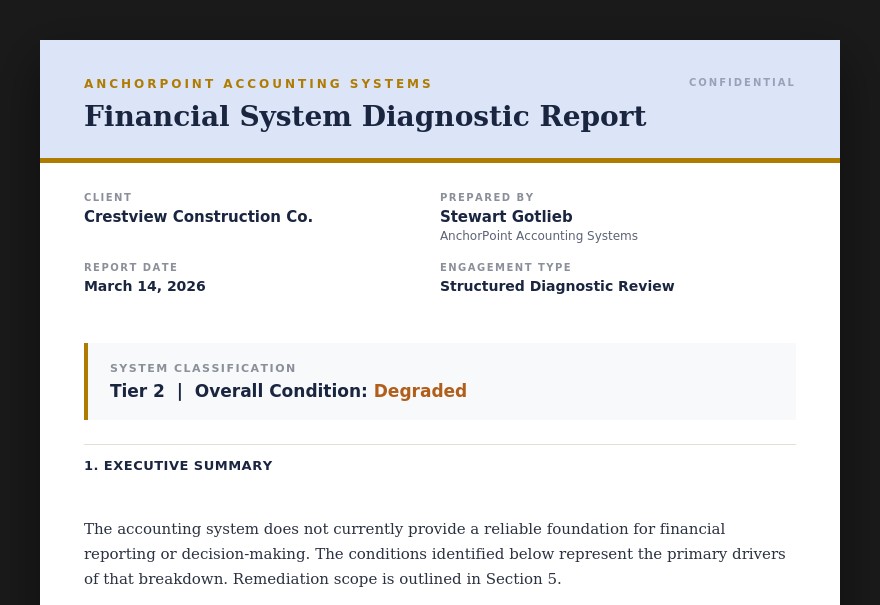
The review systematically assesses each area of the accounting system where problems typically originate or compound.
Which accounts are reconciled and current, which are behind, and where reconciliation gaps are creating downstream distortions in the financial statements.
Whether balance sheet accounts tie to actual business obligations, or whether balances have accumulated that no longer reflect real assets, liabilities, or equity.
Whether payroll liability accounts match actual filings, and whether sales tax balances accurately reflect what is owed: two of the most commonly mishandled areas in QuickBooks.
Whether clearing accounts are resolving as intended or accumulating balances, a common indicator of process breakdown and a frequent source of balance sheet distortion.
Whether the chart of accounts is organized to produce reliable, readable financial reports, or whether structural issues in the account setup are distorting the picture.
Whether the income statement and balance sheet are currently producing numbers that leadership can rely on for business decisions, or whether the reports have drifted from operational reality.
Three structured phases that move from initial conversation to written findings to a clear path forward.
We begin with a conversation about the current state of the books, the history of the account, and what symptoms have been observed. This frames the scope of the assessment before we begin.
A methodical review of reconciliation status, balance sheet accounts, liability balances, clearing accounts, chart of accounts structure, and financial reporting reliability.
You receive a written summary of what was found, how the condition is classified, what remediation is recommended, and what the engagement scope would be if you proceed.
At the conclusion of the review, you have a clear and documented understanding of the system’s actual condition, not an estimate, not assumptions.
Remediation work is targeted, structured, and appropriate for the actual condition of the accounting system, not scoped on assumption or visual inspection alone.
In addition to the findings summary and remediation roadmap, each diagnostic establishes a baseline view of system health, providing a clear starting point for both cleanup and ongoing monitoring.
Next stepIf your financial reports have become difficult to trust or reconciliations have fallen behind, a Structured Diagnostic Review is the appropriate starting point. Contact AnchorPoint to begin the diagnostic process.
Financial reports no longer match what you’re seeing in the business
Reconciliations are behind and you’re not sure how far back the issues go
You’ve had cleanup work done before, and the same problems came back
Balance sheet accounts have balances that don’t correspond to real obligations
Payroll or sales tax liabilities don’t tie to actual filings
Cleanup work feels uncertain. You’re not sure what’s actually broken
The goal of the diagnostic is not just to identify issues. It’s to establish a clear path forward. For most clients, that path follows three structured phases.
Assess the actual condition of the system. Identify what is broken and why. Establish a clear remediation roadmap.
Reconcile the balance sheet. Correct liability accounts. Restore the integrity of the financial system.
Structured monthly close. All key accounts reconciled consistently. Reliable financials every period.
If your accounting system has drifted from operational reality, a Structured Diagnostic Review is the correct first step. No sales pressure — just a diagnostic conversation.
Schedule a Diagnostic ReviewBirmingham, Alabama · Serving businesses nationwide
Or call: (205) 719-6480